
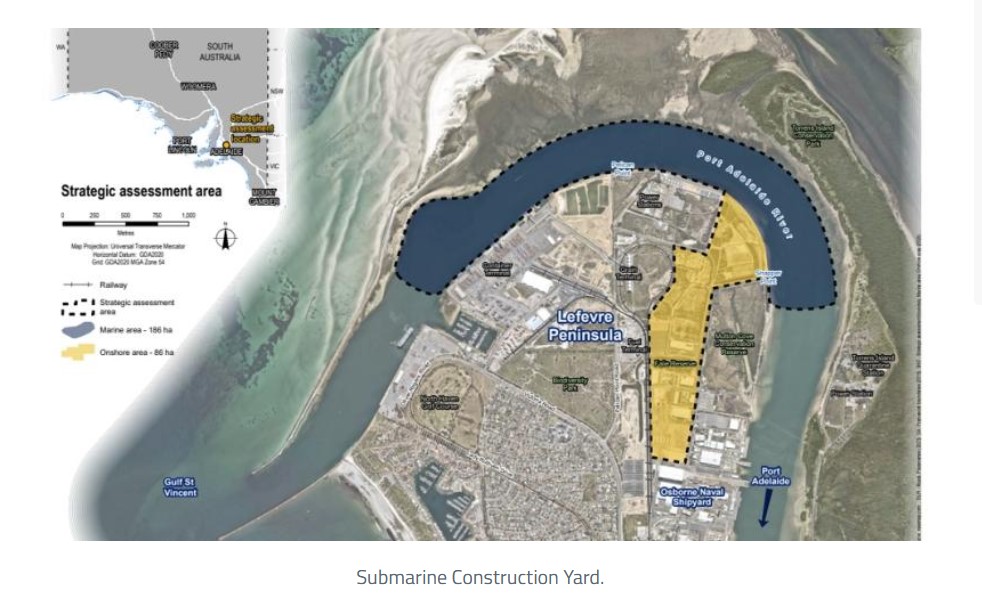
As the Commonwealth and State Governments develop plans for expanding the Osborne shipyard, several major environmental reports were released for public comment:
- Australian Naval Infrastructure’s Environmental Impact Statement (EIS) and
- Australian Submarine Agency’s Strategic Impact Assessment Report (SIAR).
Both were open for public comment from Monday 3rd February until Monday 17th March, 2025.
The Friends of Port River responded to the EIS and SIAR with written submissions:
Response to draft EIS_Friends of Port River
Response to Strategic Impact Assessment Report_Friends of Port River
ANI’s EIS was developed in response to State planning processes, while ASA’s SIAR was produced for assessment by the Commonwealth Department of Climate Change, Energy, the Environment and Water (DCCEEW). Responses made to either of the EIS and SIAR were submitted to DCCEEW.
It was informative to see the reports generated in response to concurrent State and Commonwealth processes. For FPR, these processes reinforced some of the weaknesses of State assessment processes. For example, in background reports for the EIS, environmental consultants identified potential risks and proposed mitigation measures, however these were not incorporated into the EIS.
The EIS indicated that none of the matters they identified in the Mitigation Schedule will have ‘significant effects’ during the construction phase and no Additional Mitigation Measures required. The EIS relied upon the usual Management Plans, licenses and other approvals, to prevent, reduce or offset the significant adverse effects of the development proposal.
The ASA’s Strategic Impact Assessment Report at least identified that a risk rating of ‘high’ remained for clearing of vegetation, including seagrass via dredging.
With the proposed development surrounding Mutton Cove, and the maritime and dock facilities to be built near the NE edge, FPR is very concerned that both the EIS and SIAR did not adequately attend to the risk to the Mutton Cove seawall and how collapse of the seawall could impact the development, the surrounding infrastructure, the local environment and the community.
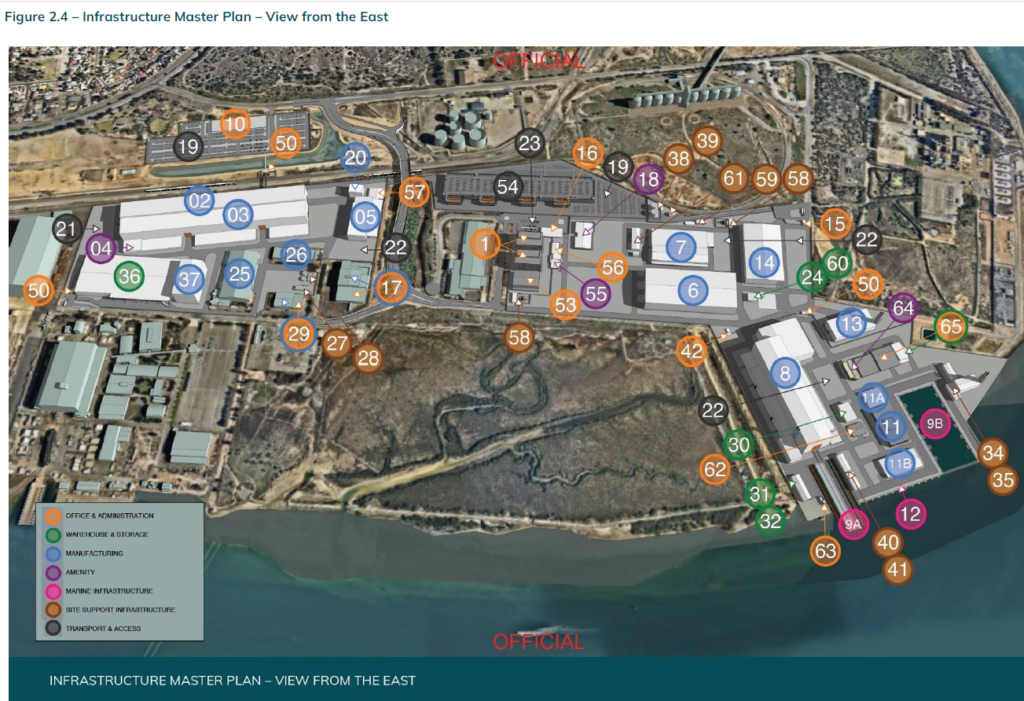
Given the major construction proposed, there would seem to be a substantial risk to the seawall and to Mutton Cove, its habitat and the species it supports. Before constructing major buildings next to Mutton Cove, to deal with potential climate risks, the land will need to be raised and often this process requires substantial preloading. Risks will also arise in constructing maritime and dock facilities, including excavation and dewatering. While Mutton Cove’s seawall has been breached at several points, the inner banks at Mutton Cove have not been built as seawalls and are also progressively eroding.
More generally, FPR supported feedback provided by the City of Port Adelaide Enfield and argued for best practice mitigation measures, community engagement with public visibility and accountability, and a commitment to enhancing the local environment
FPR wants proactive measures e.g. environmentally-friendly seawalls, employment, social infrastructure, so that the local community gets some benefit from the development, and are not asked just to bear potential problems e.g. loss of habitat, inadequate stormwater systems, flooding, traffic, pollution etc.
Within the SIAR, FPR were appreciative of
- the Outcomes & Commitments Summary (Figure 35 in SIAR) established between ASA and ANI
- the commitment to Ecologically Sustainable Development
- the Compliance and reporting processes including Annual Reporting and Auditing