
Our coastal ecosystems can store considerable amounts of ‘blue carbon’, acting as a natural climate solution. However, our local environment is dynamic, so how do losses and gains in vegetation affect blue carbon storage and dynamics?
The University of Adelaide, with funds from Green Adelaide, investigated over 2024 and 2025
- Zostera seagrass that expanded between 2010 and 2022, along the western bank of Torrens Island, but suffered catastrophic loss during an extreme heat event in February 2023
- ongoing saltmarsh contraction and mangrove expansion at Mutton Cove since a seawall breach in May 2016
Zostera along Torrens Island
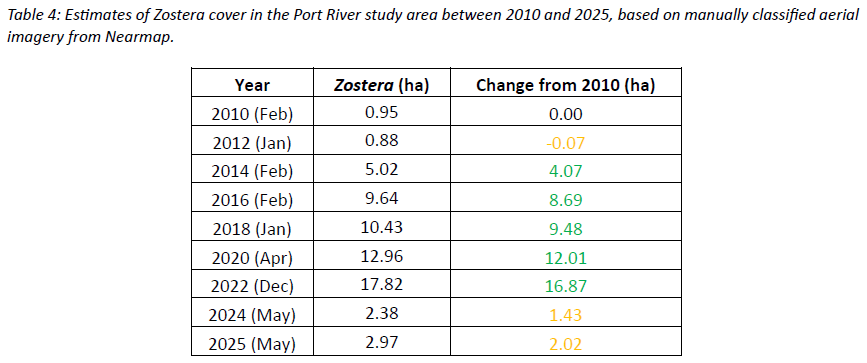
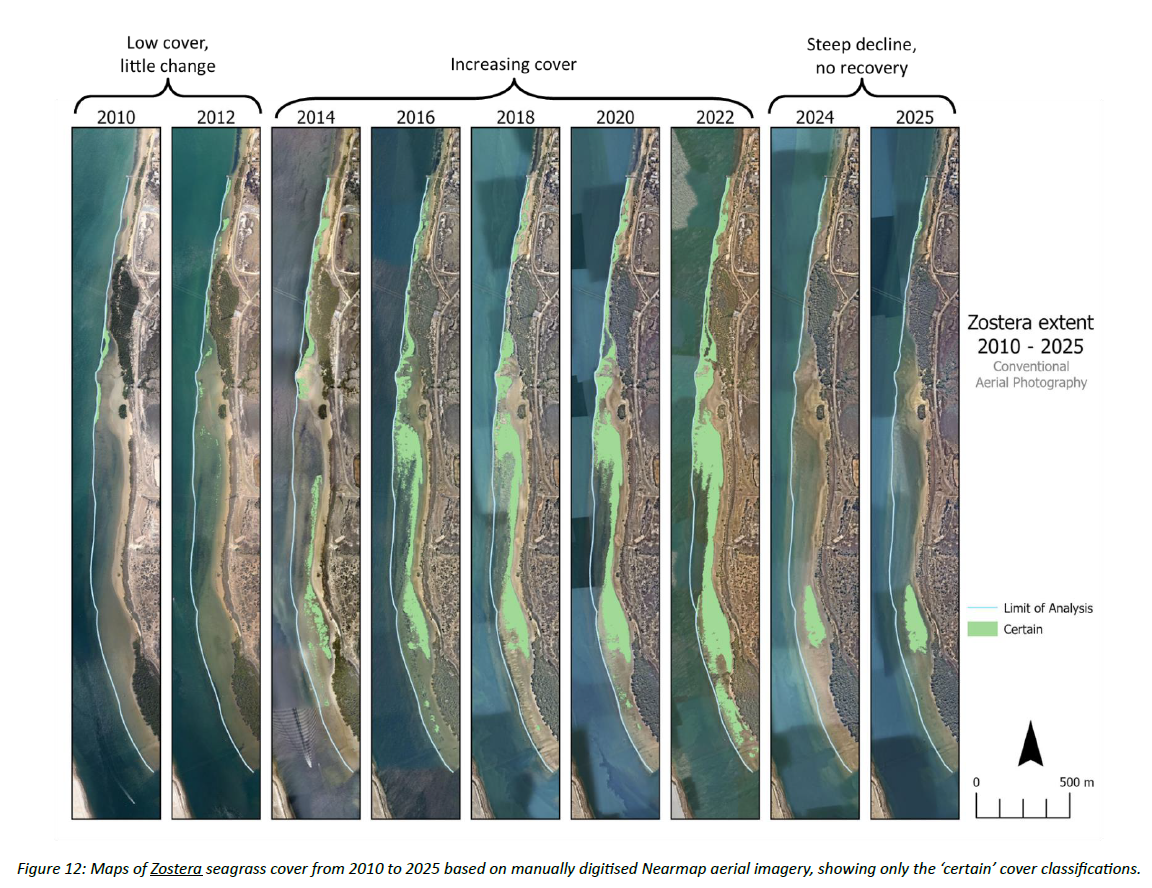
Aerial imagery from 2010 to 2025 revealed three distinct phases in Zostera seagrass cover within the Port River/Yartapuulti study area along the western bank of Torrens Island:
- low and stable cover (0.88 – 0.95 ha) between 2010 and 2014, likely linked to industrial discharges from the Penrice soda ash factory, until it closed in June 2013
- rapid expansion from 2014 to 2022, increasing from 5.02 ha to a peak of 17.82 ha—representing a nearly 17-fold increase from the 2010 baseline and an average annual expansion rate of 1.6 ha
- loss of cover in February 2023, when an extreme heat event (22nd -24th February, with maximum temperatures reaching 42 – 46 °C) coinciding with daytime low tides (0.27 – 0.32 m). Over 85 % of seagrass cover was lost, declining from 17.82 ha to just 2.38 ha. Subsequent monitoring in 2024 and 2025 showed no evidence of recovery in previously affected areas, with coverage remaining at 2.38 ha and 2.97 ha, respectively.
“One ‘resilient patch’ that initially survived the 2023 event served as a donor site for our study’s restoration trials. However, this patch subsequently succumbed to die-back following an extended marine heatwave in the region (September 2024 to mid-2025), combined with a harmful algal bloom. These findings document both the remarkable recovery potential of Zostera seagrass following improved water quality, and its vulnerability to climate-related acute and chronic events, with limited natural recovery evident in the two years following the largescale dieback after extreme heat disturbance”.
So how did the 2023 heatwave and seagrass die-back affect carbon storage in sediment?
The study examined ‘Persistent Zostera’ (present for at least ten years), ‘New Zostera’ patches, (that had only emerged since 2014) and ‘Persistent Bare’ patches (bare for at least 10 years)
In 2020 Persistent Zostera exhibited strong surface (0 – 10 cm) enrichment of organic carbon from 1.73 % at 5 cm depth to 0.39 % at 35 cm depth. Persistent Zostera and New Zostera both had organic carbon stocks in the surface sediment that significantly exceeded the Persistent Bare patches.
Following the 2023 die-back higher surface concentrations were replaced by uniform, low concentrations (0.09 – 0.45 %) of organic carbon throughout the 0-50 cm profile across the three habitat types.
There was a 60 % loss in surface carbon stocks from the areas previously covered by Persistent Zostera, and a 41 % decline in the areas previously covered by New Zostera.
However, while the surface sediments (0-10 cm) in established seagrass lost considerable carbon following die-back, deeper legacy carbon (below 10 cm) remained more protected and stable.
“This has important implications for blue carbon accounting, indicating that not all seagrass-associated carbon is equally vulnerable, and that disturbance impacts may be confined to more recently deposited surface carbon while leaving deeper carbon reserves intact”.
The University also attempted a Zostera restoration trial, with two transplant cohorts in September 2024 and March 2025, however the trials were confounded by the environmental stressors mentioned above. These were a marine heatwave from September 2024 to May 2025, that coincided with a harmful algal bloom (dominated by Karenia dinoflagellate species), which affected the Port River study area in mid-2025.
Saltmarsh and mangroves at Mutton Cove
Following the seawall breach in 2016 significant saltmarsh die-back occurred and there’s been expanding mangrove cover, so that mangroves now dominate the ecosystem.
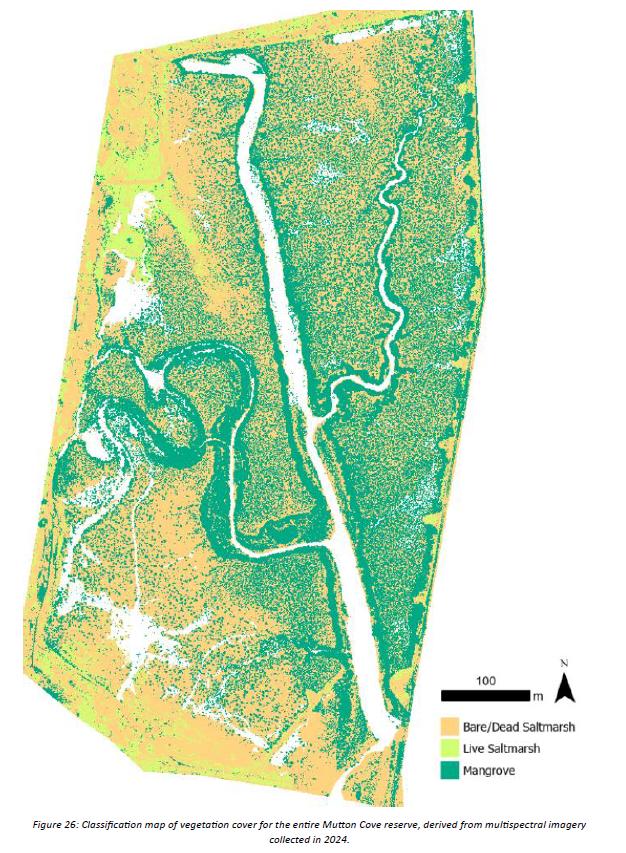
“Above-ground organic carbon stocks increased substantially from 2018 to 2024, driven by rapid mangrove expansion and the associated biomass increase compared to saltmarsh-dominated systems. Site-wide, the … system contained an estimated 2,853 t of above-ground carbon in late 2024, with mangroves contributing over 99 % of these stocks.”
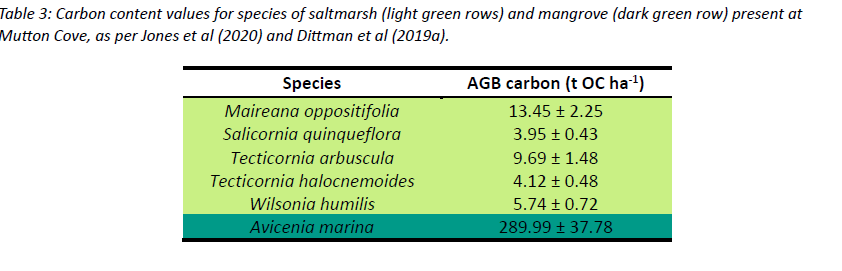
This “has resulted in an over 600 % increase in above ground carbon stock at the site over a five-year period. This significant change highlights the importance of continued, regular monitoring for dynamic blue carbon ecosystems to achieve accurate above ground carbon stock estimates, which may increase more rapidly than below ground stocks under optimal mangrove growth conditions”.
Leave a Reply